
Considering the above, Re Alloys analyses environmental aspects and monitors influence on the environment. We declare that we observe the requirements imposed by law, environmental programmes and regulations; we also take measures in the field of environmental protection that go beyond the external requirements. We constantly improve and introduce solutions which minimise our negative impact on the environment.
Re Alloys carries out a range of activities aimed exclusively at reducing the environmental impact of the plant’s operations. Ensuring an appropriate level of environmental protection involves incurring substantial costs resulting from the need to maintain numerous complex and expensive installations, such as the Water Treatment Station or the high-efficiency flue gas dedusting system.
The nature of the production process is inherently linked to its impact on the natural environment through emissions into the air. Reducing this impact is a priority for us. We are committed to ongoing efforts to minimise our environmental footprint and to applying the principle of continuous improvement to both our environmental management system and our pro-environmental activities. In addition, annual environmental fees are paid for the plant’s impact on the environment. These fees finance environmental tasks carried out by public institutions.
Our GHG emission reports are verified by an independent auditor and are regularly submitted to the relevant environmental authorities.
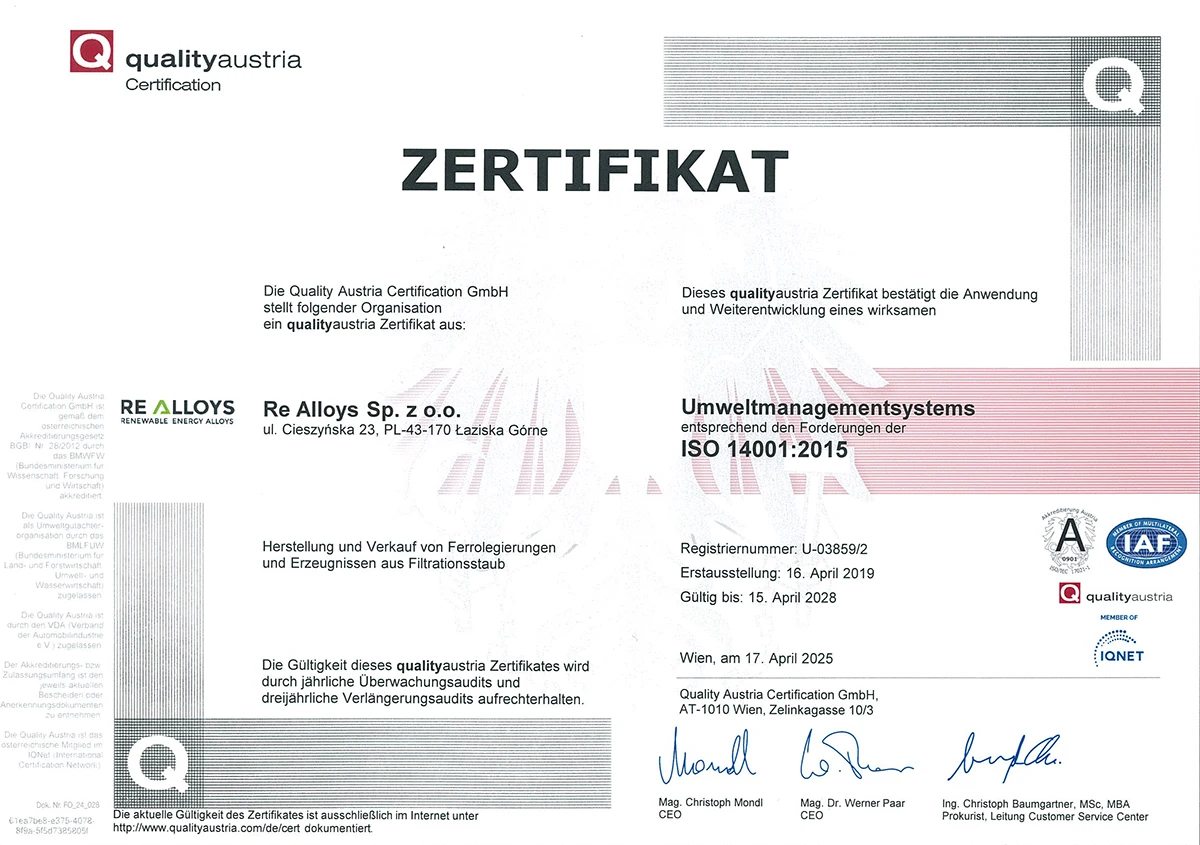
In our activities we aim at full compliance with the applicable law and other regulations and provisions regarding the environmental protection, as well as with the voluntarily adopted requirements of the ISO 14001 norm. In the Environmental Policy and in the Environmental Management System Manual we undertake to take continuous measures for minimising the negative impact on the environment and to apply the principle of constant improvement of the environmental management system and our environmental activity. The environmental management system used in our organisation is assessed by independent auditors, what is confirmed by the ISO 14001 Certificate.
At the Plant, we supervise the waste management and we proceed with waste in compliance with the law. The waste generated by the Plant undergoes the recovery process at the Plant or is submitted to entities having the required administrative decision on the waste collection in place. Each tonne of waste leaving the premises of the Plant goes to verified and authorised entity.
Pro-environmental initiatives are not only about reducing our impact on the surroundings, but also bring tangible benefits to the Company. Thanks to a range of environmental measures — including the rational management of waste, the dedusting of post-reaction gases and the recovery of heat from the production process — we are able to minimise our costs.
The heat recovered from the production process fully covers our needs for the central heating and domestic hot water systems. Previously, the required heat had to be purchased in large quantities from an external district heating network, which generated additional CO₂ emissions at the source.
In order to minimise water consumption by the Company, all industrial water is obtained by re-using of social sewage and rainwater from the combined sewer system. The water treatment is conducted on the water treatment station. It allows restoring properties to used water what makes it fit for re-use as cooling water.
The effect of water treatment in the Company is:

WATER CONSUMPTION IN THE PLANT.
Water from the water supply network is used for social and industrial purposes. Industrial consumption is primarily:
Groundwater from SŁG-1 water intake, due to its very low quality, undergoes the coagulation process in the water treatment station (Stacja Odnowy Wody / SOW) and, along with reclaimed water, it is used to replenish cooling systems.
Industrial water is used to replenish external cooling systems. The systems are used to cool the furnace units at furnace buildings (Piecownie) no. I and II – the Central Pumping Station (Pompownia Centralna) and furnace building no. IV – the central pumping station, furnace building no. IV. Water loss is proportional to the amount of heat received by the cooling tower.
1. Tap water is purchased from RPWiK Tychy. The companies have three water connections located at:
2. Groundwater is obtained from the water intake SŁG-1 with the following parameters:
The water intake is located in the water treatment station (Stacja Odnowy Wody). The collected water is treated in the process of coagulation and it is used to replenish the cooling systems.
3. Water is recovered from sewage flowing into the combined sewer system.
Sewage is treated in a biological wastewater treatment plant and collected in two retention reservoirs with a total working capacity of approximately 3,300 m3. Pre-treated sewage is treated in decarbonisation, coagulation and filtration processes. The excess of treated wastewater is discharged into trench G (Rów G).
This page uses cookies to help us in providing our services at the highest level. By using our website, you agree to the use of cookies.